+27 (0)11 683 4541 [email protected]
Khanyisa Nursing School classroom

Programmes built on practice

Every Khanyisa programme is HEQSF aligned, DHET registered and structured to put students at the bedside as often as in the lecture theatre.

Programme Suite

Two qualifications. One calling.

Both qualifications below are offered at all five campuses in full-contact mode and are registered under DHET registration number 2018/HE07/003 until 31 December 2027.

NQF 5 · 120 Credits · 1 Year

Higher Certificate in Nursing

(Previously the Higher Certificate in Auxiliary Nursing — HEQSF aligned)

Full-time Contact Mode SAQA ID 110269
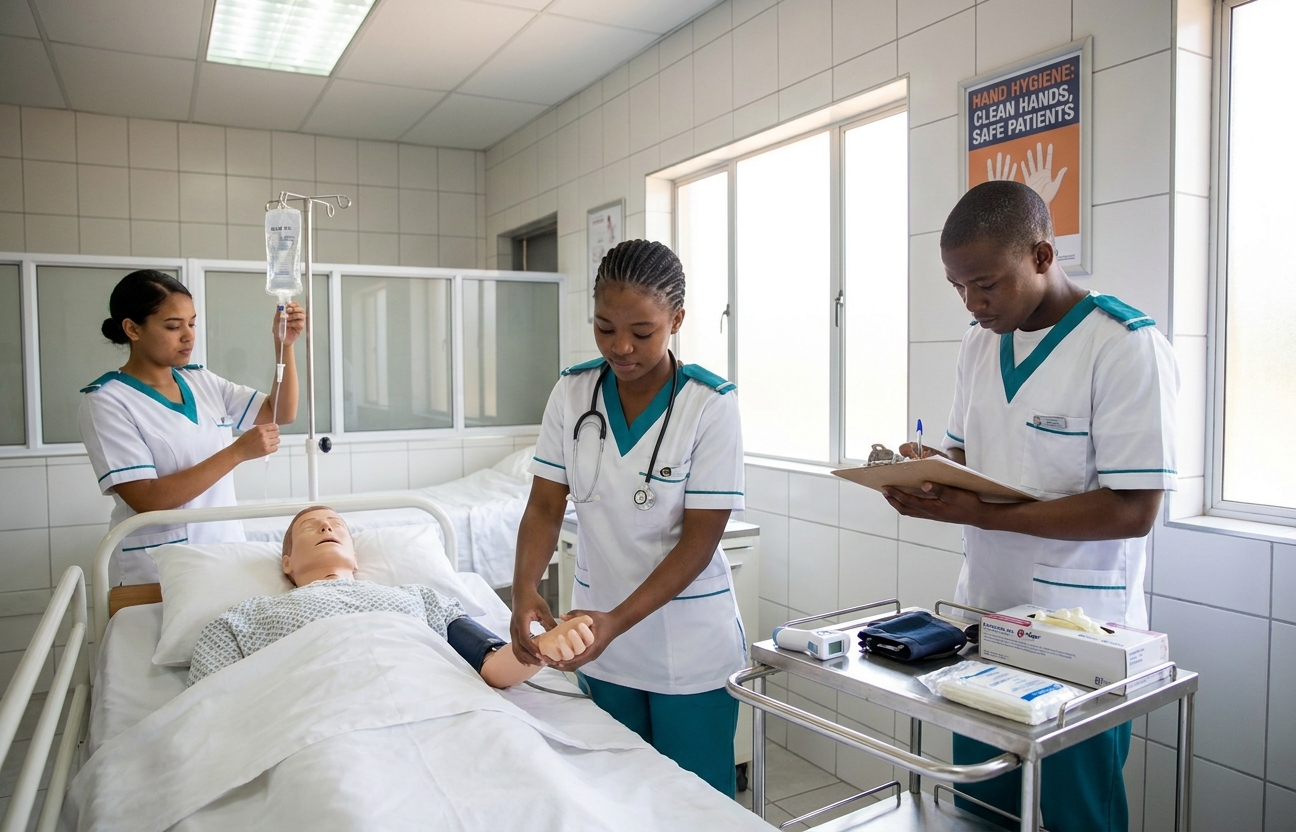
Higher Certificate students practising

Programme purpose

This one-year qualification develops competent, ethical auxiliary nurses able to provide elementary nursing care under the supervision of a registered nurse — across primary healthcare, sub-acute, community and home-based contexts.

Core modules

  • Fundamentals of Nursing Science I & II
  • Anatomy, Physiology & Microbiology
  • Basic Pharmacology & Medication Administration
  • Personal & Professional Development for Nurses
  • Health Assessment & Vital Signs
  • Community & Primary Health Nursing
  • Clinical Practice I (Min. 1,000 hours supervised)

Entry requirements

  • Grade 12 / NSC certificate with English at minimum 40%
  • Mathematics or Mathematical Literacy at 30%
  • Life Sciences at 40% (recommended)
  • South African ID or valid study permit
  • Medical fitness certificate & clear police clearance

Career pathways

Graduates qualify for registration with the South African Nursing Council (SANC) as Enrolled Nursing Auxiliaries. Typical employers include public hospitals, private hospital groups (Netcare, Life, Mediclinic), step-down facilities, hospices, frail-care centres, and home-care agencies.

NQF 6 · 360 Credits · 3 Years

Diploma in Nursing

(HEQSF aligned · Replaces the legacy R425 four-year programme for the new SANC framework.)

Full-time Contact Mode SAQA ID 110301
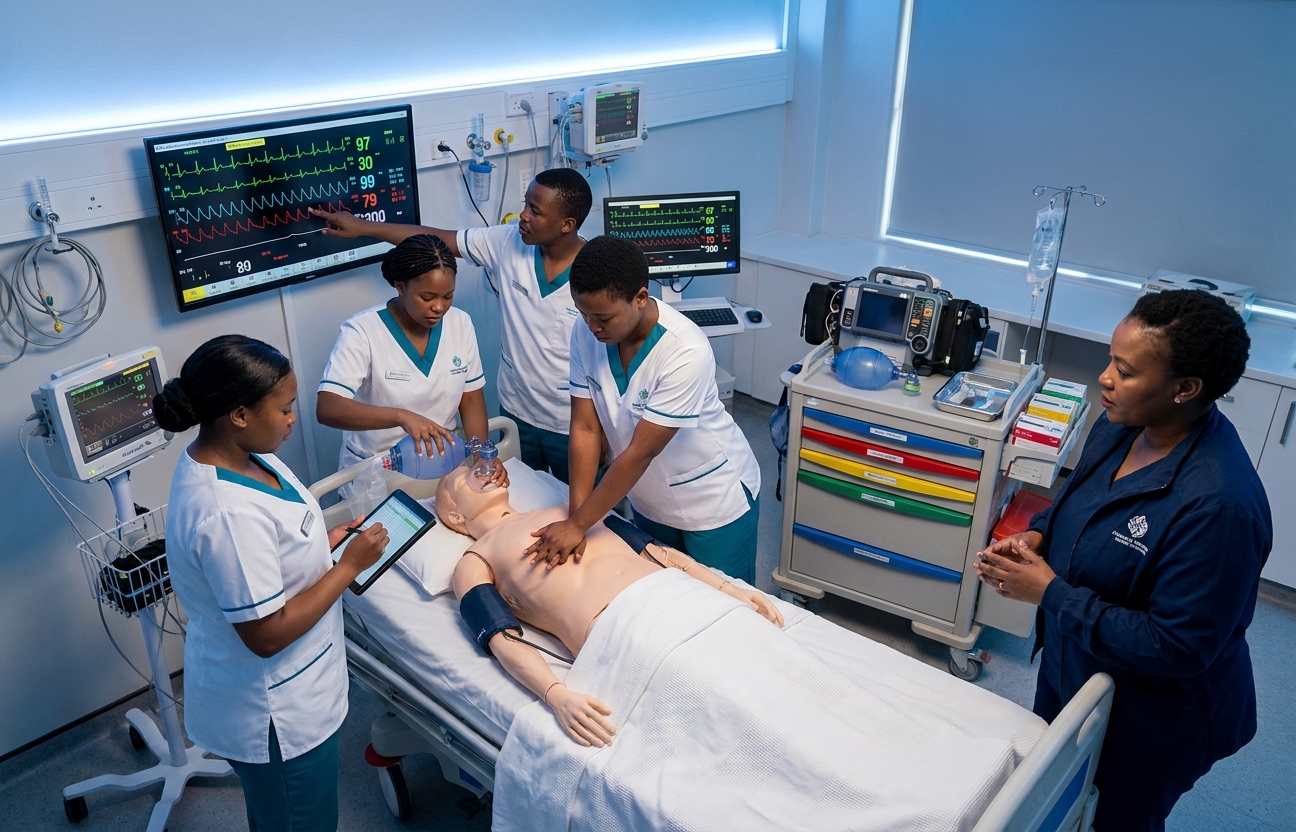
Diploma students in simulation lab

Programme purpose

A three-year qualification preparing graduates to render comprehensive nursing care as general nurses, with foundations in midwifery and psychiatric nursing science, evidence-based practice and clinical reasoning.

Programme structure

Year 1 — Foundations of nursing: Anatomy & Physiology, Sociology of Health, Microbiology, Nursing Science I, Pharmacology I, Clinical Practice I.

Year 2 — Applied nursing: Pathophysiology, Pharmacology II, Mental Health Nursing, Maternal & Child Health, Nursing Science II, Clinical Practice II.

Year 3 — Integrated practice: Advanced Clinical Nursing, Community Nursing, Nursing Management, Research Methods, Ethics & Law, Clinical Practice III & Capstone Portfolio.

Entry requirements

  • NSC with Bachelor’s or Diploma endorsement
  • English Home Language or First Additional Language ≥ 50%
  • Life Sciences ≥ 50% and Mathematics or Mathematical Literacy ≥ 40%
  • Clear police clearance & medical fitness certificate
  • Mature-age entry (RPL) considered for applicants 23+

Career pathways

Graduates qualify to register with SANC as General Nurses, and may continue to a SANC-accredited Postgraduate Diploma in Midwifery, Psychiatric or Specialist Nursing. Career roles include ward nurse, theatre nurse, community health practitioner, occupational nurse, and case manager.
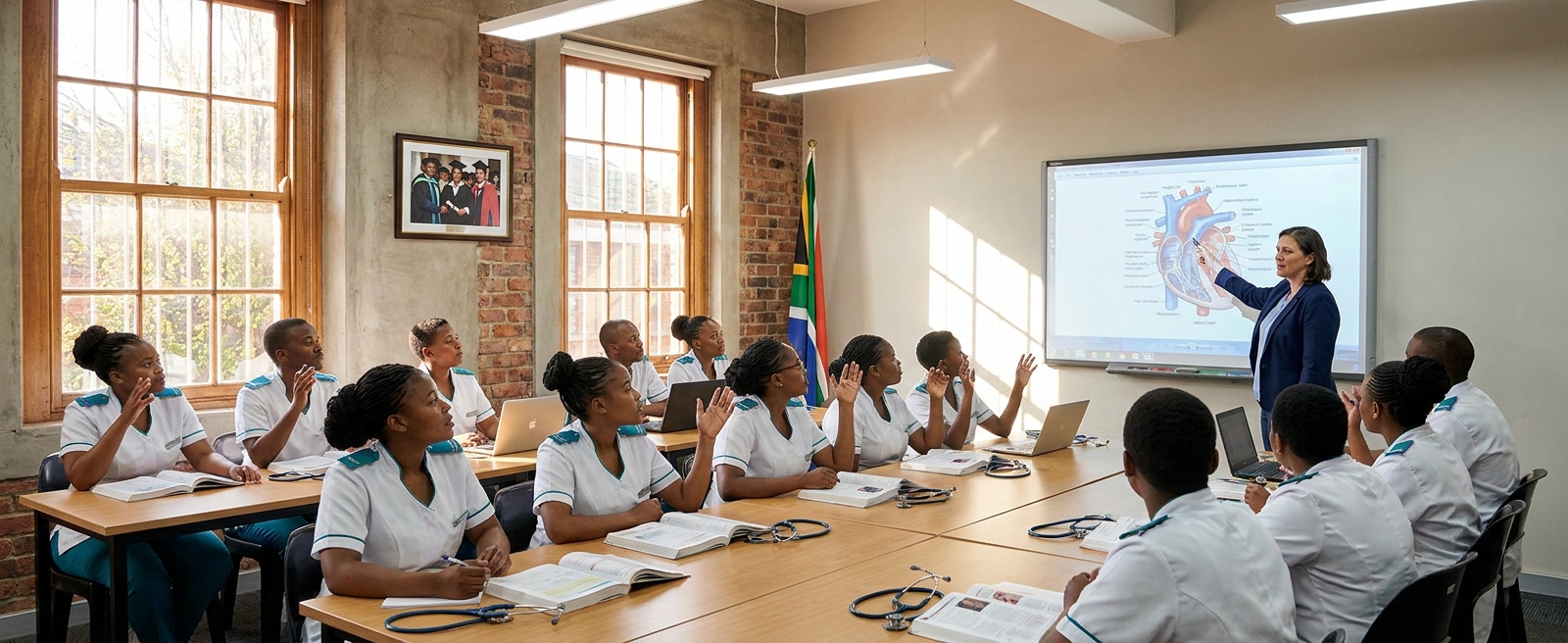
Inside the classroom

An education built around the patient

Khanyisa lecturers design every module around real clinical encounters. Each week of theory is anchored to a clinical scenario you will meet on placement — from a child with severe diarrhoea in a Mpumalanga clinic to an elderly mineworker presenting with silicosis on a Witbank ward.

  • Small classes — average 28 students per cohort.
  • Simulation-first — every clinical skill is practised on a high-fidelity manikin before a patient.
  • Bilingual case studies in English with isiZulu, Xitsonga, Sesotho and siSwati glossaries.
  • Formative feedback every fortnight — no surprises at exam time.
Curriculum study desk
Frequently asked

Programme questions, answered

Are Khanyisa qualifications recognised by SANC?

Yes. Both qualifications meet the new South African Nursing Council (SANC) framework. Graduates are eligible to register with SANC in the appropriate category upon successful completion and submission of a clinical portfolio.

Can I bridge from the Higher Certificate into the Diploma?

Higher Certificate graduates may apply for credit-bearing recognition into the Diploma programme through our Recognition of Prior Learning (RPL) process. Up to 60 credits may be recognised based on transcripts and an entry assessment.

How is clinical practice organised?

Clinical placements are arranged by Khanyisa at our partner facilities. Students rotate through general, maternal, paediatric, psychiatric and community settings under qualified preceptors. Travel between sites is supported by a campus shuttle network in Mpumalanga.

What language is teaching offered in?

The medium of instruction is English. However, lecturers and clinical preceptors are conversant in the local languages of each campus — including isiZulu, Sesotho, Xitsonga, siSwati, isiNdebele and Afrikaans — to support bedside communication.

What uniform and equipment will I need?

A uniform pack (two tunics, navy trousers, white socks, leather shoes, two name badges, lanyard, stethoscope and watch) is included in first-semester fees. Students provide their own textbooks; second-hand textbook pools are organised by our SRC.

Ready to choose your programme?

Our admissions team is here to help match you to the right qualification and the campus closest to where you can thrive.

Speak to Admissions